
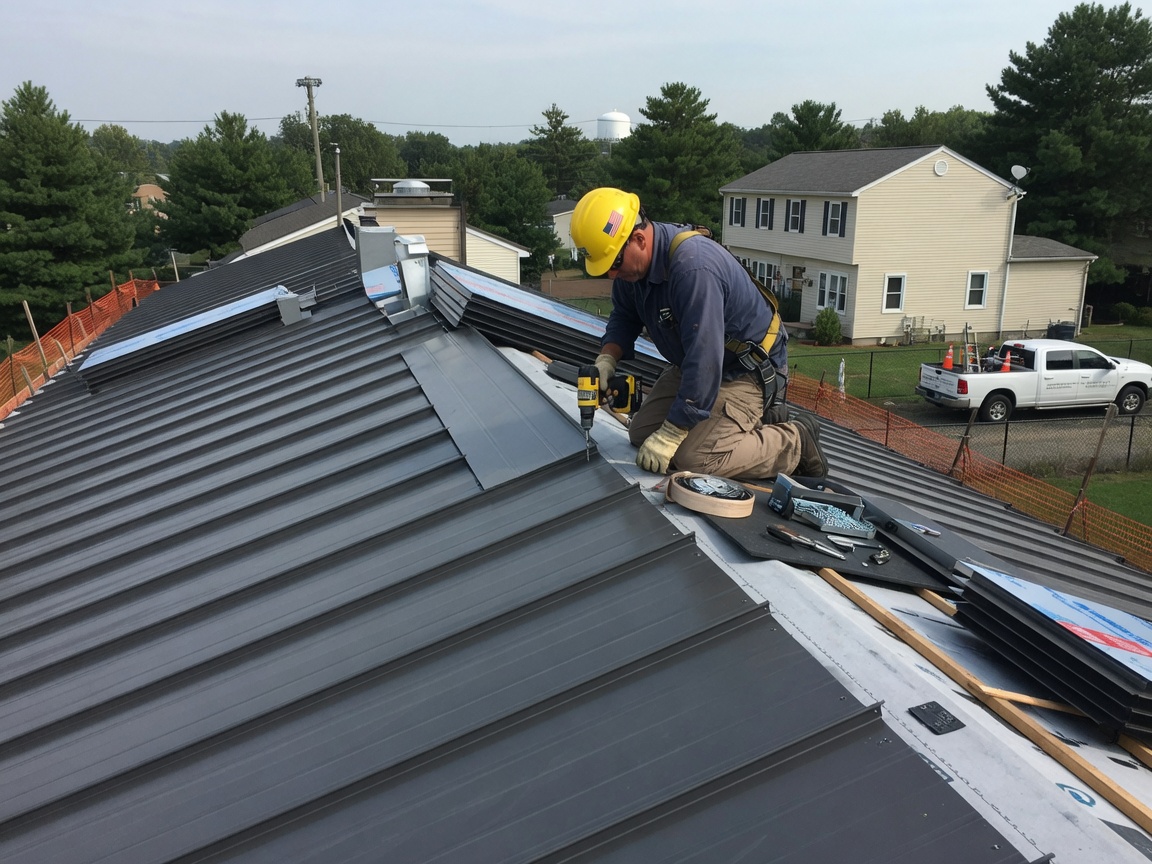
Metal roofing has gained real ground across South Jersey, and for sound reasons: a 40 to 50 year service life against 25 to 30 for asphalt, far better snow shedding, and reflectivity that keeps summer heat out of the attic rather than driving it in. The trade-off is up-front cost and the fact that it is less forgiving of poor installation than shingles are.
Standing seam versus exposed fastener. This is the decision that matters most. Screw-down panels are held by hundreds of exposed fasteners with rubber washers, and those washers degrade under UV. They need periodic re-torquing and eventually replacing, and every one is a potential leak. Standing seam conceals the fasteners beneath the seams, so there is nothing exposed to fail — which is why standing seam roofs last decades with little attention and screw-down roofs develop a reputation for weeping at the fasteners. Screw-down still makes sense on outbuildings, garages and barns where cost dominates.
Thermal movement is the thing installers get wrong. Metal expands and contracts substantially more than asphalt across a year of South Jersey temperatures. Standing seam systems accommodate this through clips that let the panel slide; fix a panel rigidly at both ends and it will either oil-can into visible waviness or work its fasteners loose. On retrofits over older homes we check deck flatness before anything goes down, because wide metal panels telegraph every dip in the sheathing in a way shingles simply do not.
Galvanic corrosion. Dissimilar metals in contact with water between them corrode. Steel panels tying into copper gutters or aluminium flashing need the right separation and the right fastener metallurgy. It is an unglamorous detail that shows up as staining and premature failure at the eaves a few years in.
Ventilation still applies. A metal roof does nothing to fix a badly ventilated attic. Ridge venting has to be paired with adequate soffit intake or humid summer air sits against the underside of the panels and condenses. We size intake and exhaust to the actual attic volume as part of the job rather than assuming what is there already works.
Permits. Roofing work in New Jersey falls under the state Uniform Construction Code, with permitting and inspection handled by your municipal construction office. Requirements vary by township and change over time, so we confirm what your municipality currently requires and pull the permit as part of the job.
Technician insight
The thing that catches people out with metal is deck flatness. Wide panels telegraph every dip and hump in the sheathing underneath, so a deck that looked perfectly acceptable under shingles can read as visible waviness once metal goes over it. On retrofits we check the deck plane before committing to standing seam, because the complaint afterwards is never about leaks — it is about how it looks in raking afternoon light.
Standing seam retrofit on a 1968 ranch
Ceiling stains appeared after a January thaw on a low-pitch screw-down metal roof. The butyl tape at the ridge had failed and several fastener washers had perished. We removed the old panels, corrected the deck plane, installed proper thermal clips and new ridge venting, and reinstalled in standing seam. No further leaks through the following winter.
Metal Roofing Services We Offer
✓Standing Seam Metal Roofing
Hidden-fastener panels with clips that allow thermal movement — the long-life option, with nothing exposed to fail.
✓Metal Roof Installation
Full replacement in standing seam or screw-down panels, sized and specified to the home.
✓Metal Roof Repairs
Dented panels, perished fastener washers and failed seams — the usual faults on older screw-down roofs.
✓Corrugated Metal Roofing Replacement
Replacing outdated wavy panels on garages, barns and outbuildings with modern coated steel.
✓Metal Roof Leak Detection
Locating hidden water entry on metal roofs, where the entry point and the interior stain are often far apart.
Metal Roofing Cost in Waterford Works, NJ
| Service | Typical Range | What Affects It |
|---|---|---|
| Standing seam metal roof | $8–$14 per sq ft | Roughly $9,000–$18,000 on a typical home, depending on gauge, colour and number of penetrations |
| Screw-down corrugated panel | $5–$9 per sq ft | Lower-cost option, usually chosen for garages, barns and outbuildings |
| Metal roof leak repair | $175–$350 | Sealant or a panel section; larger seam work is quoted separately |
| Quote for metal roofing work | Free | On-site visit, scope and written itemized price. No charge, no obligation. |
Ranges are typical for Waterford Works, NJ and confirmed with an exact written quote before any work starts.
How it works
- 1
Site Assessment
Walk the roof and the attic to measure pitch, assess deck condition and flatness, and check what ventilation is actually there.
- 2
Material Selection
Standing seam or screw-down, gauge, coating and colour — chosen against sun exposure, tree cover, budget and how visible the roof is.
- 3
Preparation and Underlayment
Remove the old roofing, repair or replace decking, correct deck plane where panels would telegraph it, and install underlayment with ice-and-water shield at eaves and valleys.
- 4
Panel Installation
Panels set with clip spacing that allows for thermal movement, then flashing at every penetration, valley and ridge.
- 5
Final Inspection
Seams, fasteners and flashings checked, ventilation confirmed, debris removed and a walk-through with you.
Pricing
Free on-site quote and a written itemized price. Cost varies with roof size, pitch, panel system and existing deck condition — we do not price metal roofs from photographs.